

Why give an autistic person a QR Code ID
A sensory meltdown at the mall, a child who wanders off at the beach, a teenager who doesn’t answer a police officer: in moments like these, people nearby want to help but don’t know how. A touch, a loud voice or a repeated question can make everything worse. A QR Code ID gives that stranger, in seconds, the instructions the family would give if they were there.
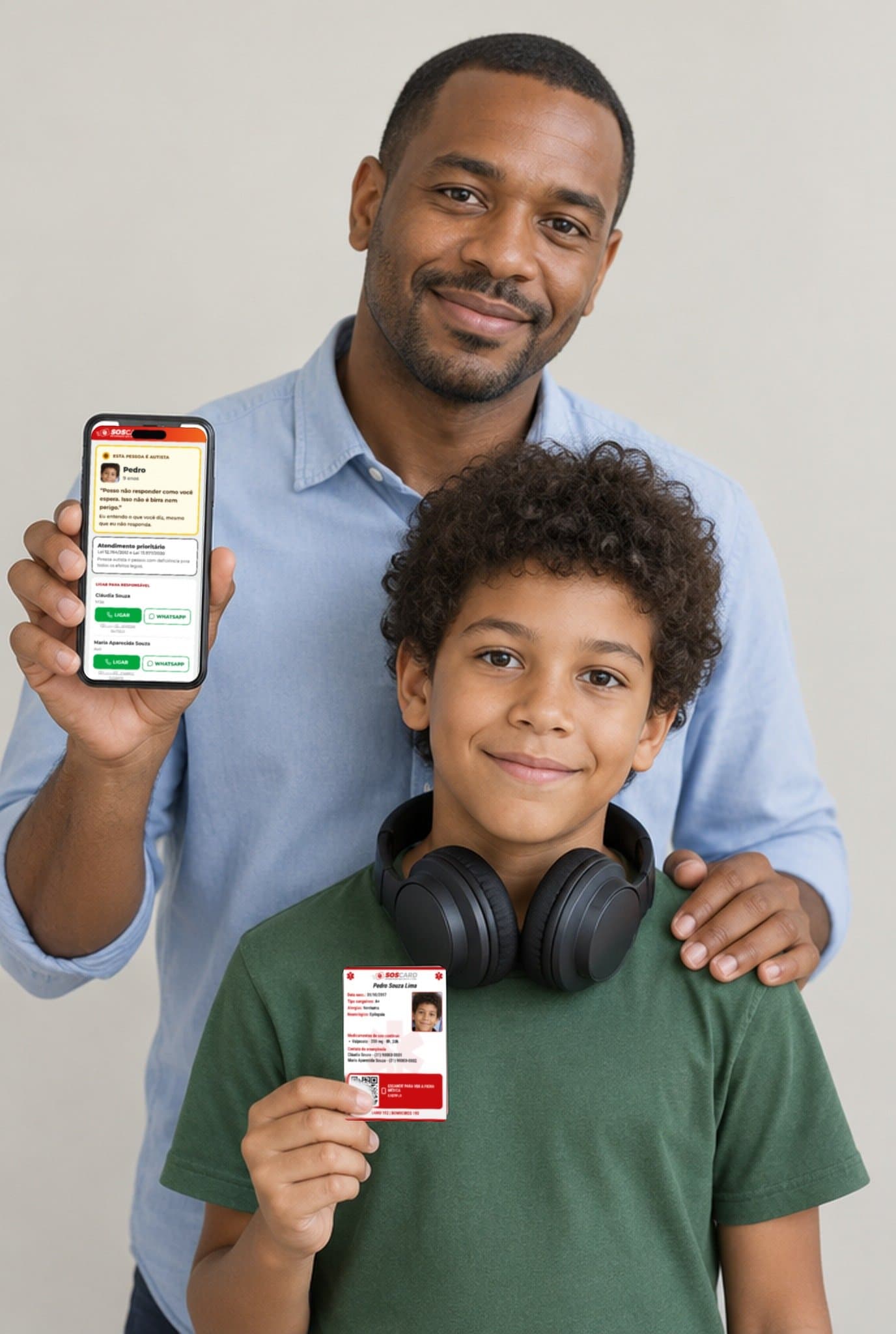
SOS Card has a record template made specifically for autism. It opens with a yellow highlight, the person’s name and the sentence “I may not respond the way you expect. This is not a tantrum or a threat.” — and it puts the guardian’s phone number before any medical information.
What to include in the record
You fill it in on your phone and change it whenever you want. The fields were designed for someone who finds the person at a hard moment:
How to communicate
Explain how to talk to them: short sentences, no touching, show instead of asking, let them type on their own phone. There’s also an “understands even without answering” option, so no one talks about them as if they weren’t listening.
Triggers and what not to do
The record has a “do this” list and a “don’t do this” list. For example: don’t grab their arm, don’t shout, move away from loud noise. Plus a risk banner for anyone who needs to know fast: may run away, has no sense of danger, is drawn to water, doesn’t respond to their name or may not recognize uniforms.
What calms them
An object, a favorite topic, a quieter spot, noise-canceling headphones. This field is often what helps a stranger the most to wait for the family without the meltdown escalating.
Contacts and health
Guardians come first, with a call button. Right below are blood type, allergies, conditions and medications — only what you marked as emergency information. The record opens in English, Spanish or Portuguese.
Where to use it: bracelet, badge and backpack
The SOS Card autism ID comes in three pieces, each with its own QR (you can deactivate just one):
- Bracelet: it stays on the body, which matters for people who tend to wander. Pick a material the person tolerates — for some, texture is a trigger.
- PVC badge, the size of a credit card, to wear on a lanyard or keep in a wallet. Handy to show at a counter when asking for priority service.
- Backpack tag: the school backpack goes with the child on the bus, on outings and on field trips.
You choose the symbol: sunflower, rainbow infinity, puzzle piece or a discreet mode that doesn’t say “autistic” or mention the diagnosis.
Brazil’s CIPTEA, Law 12,764/2012 and the role of SOS Card
SOS Card was born in Brazil, where the law protects autistic people in a specific way. Law 12,764/2012 (the Berenice Piana Law) created the National Policy for the Protection of the Rights of People with ASD and establishes that autistic people are considered people with disabilities for all legal purposes. In 2020, Law 13,977/2020 (the Romeo Mion Law) amended it and created the CIPTEA, Brazil’s official ID card for people with Autism Spectrum Disorder. It’s free, issued by state and city agencies, requested with a medical report, and valid for five years. Outside Brazil, check the official ID or registry available where you live.
The sunflower lanyard (Brazil’s Law 14,624/2023)
In Brazil, Law 14,624/2023 added the lanyard with sunflower prints to the Statute of Persons with Disabilities as the national symbol of hidden disabilities, autism among them — the same Hidden Disabilities Sunflower used in many countries. Wearing it is optional: not wearing it takes away no rights. And the lanyard doesn’t replace the document that proves the disability, if one is requested.
The combination makes sense: the lanyard signals from a distance that different care may be needed; the QR badge hanging from it explains which.
A QR Code is not a tracker
Many people search for an “autism GPS tracker bracelet”. To be honest: a QR Code is not GPS. It doesn’t show where the person is all the time and doesn’t replace a tracker with a battery and SIM. It works when someone finds the person and scans it.
At that moment, on the Complete and Family plans, you get a scan alert (in the app and by email) with the approximate city and, if the person scanning allows it, their phone’s location. If your child goes missing, you switch on missing-person mode: the record opens with a “this person is being searched for” notice, a button to call the family and one to send the location. Every scan becomes an urgent alert. Call the police too (190 in Brazil, 911 in the US): you don’t need to wait 24 hours.
To see what the record looks like to someone scanning it, open the sample record. If your family member is also older or has memory loss, see the page on ID for seniors with Alzheimer’s.