

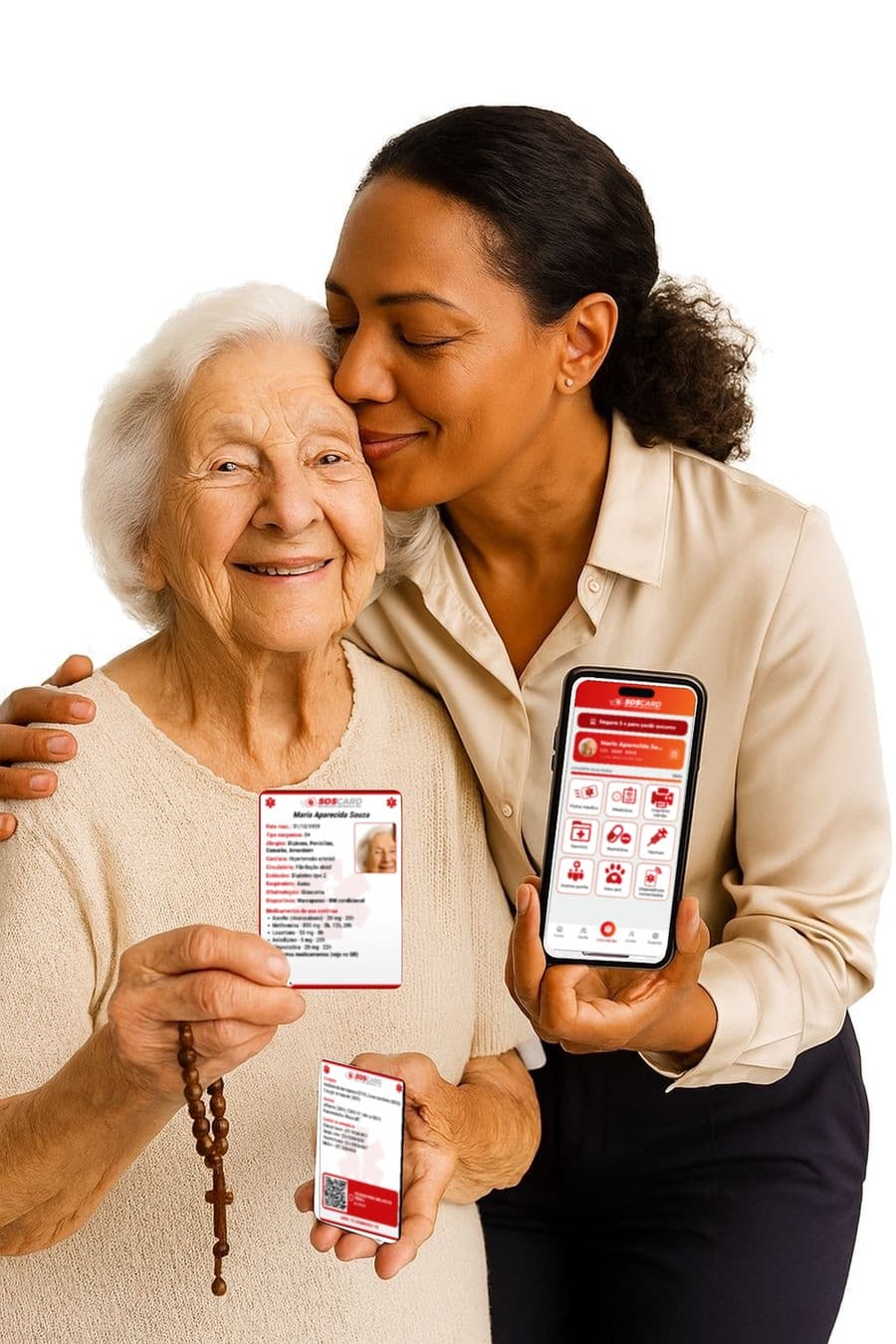
Every caregiver’s fear
Anyone caring for someone with Alzheimer’s or another dementia knows the scene: a few minutes of distraction, an open door, and they’re out on the street with no idea how to get home. Often they can’t remember their own address, their children’s phone numbers or the names of their medications. Sometimes questions frighten them and they become agitated. Whoever finds them wants to help but doesn’t know where to start.
A QR Code ID is that starting point. On a bracelet or a card, a code any phone can read opens the emergency record in the browser — no app, no password.
Made for caregivers
The person wearing it doesn’t have to do anything. The family manages it from their own phones:
- Several caregivers on the same record. Share the profile by email with siblings, a hired caregiver or a care home, each with the access level you choose.
- Scan alerts. On the Complete and Family plans, every time the QR is scanned, you and the profile’s managers get an alert in the app and by email, with the approximate city (based on the internet connection). If the person scanning allows it, their phone’s exact location comes through too.
- Access log. The full layer of the record only opens for someone who identifies as a health professional, and you can see who accessed it, when and from where.
- Updates without replacing the piece. Medication or dose changed? Edit it in the app; the bracelet stays the same.
Missing-person mode
If she goes missing, call the police (190 in Brazil, 911 in the US) and turn on missing-person mode in the app. You don’t need to wait 24 hours to report someone missing. With the mode on:
- The record opens with a notice that the person is being searched for, since when, and her photo, if you choose to show it.
- Your note appears — for example, what she was wearing and the places she usually heads to.
- Whoever found her has a button to call the family and a button to send their location.
- Every scan becomes an urgent alert, and the location sent arrives instantly with a map link.
- The app creates a poster to print or share on WhatsApp — no QR and no health data.
What to put on the record
ID and contacts
Full name, age, a recent photo and at least two emergency contacts with phone numbers. Contacts appear with a call button.
Health
Blood type, allergies (especially to medications), conditions like Alzheimer’s, diabetes or high blood pressure, and ongoing medications with doses. Items you mark as “professionals only” aren’t shown to just anyone.
Quick instructions
This is the field that helps a stranger most. Write simple sentences, such as: “She has Alzheimer’s and may be confused. Speak slowly and calmly, don’t argue. Call her daughter before taking her anywhere.”
The record opens in English, Spanish or Portuguese, matching the language of the phone that scans it.
Bracelet or wallet card?
A bracelet stays on the body, so it isn’t lost with a purse and doesn’t depend on someone searching a wallet. It’s the best choice for someone who tends to wander off alone. Pick a clasp the person can’t — or won’t want to — take off.
A card goes in the wallet, next to their ID, with the most critical information printed on it, so it works even without internet. First responders and hospital staff usually look for documents in a wallet.
Ideally, use both, linked to the same record. For other family members, see also the QR pet tag.
Belo Horizonte, Brazil: a QR Code ID law
In Belo Horizonte — the Brazilian city where SOS Card was born — the City Council gave final approval on July 14, 2026, to bill PL 412/2025, introduced by councilwoman Professora Marli. It authorizes the city to provide QR Code bracelets or cards to older adults, people with disabilities and people with health conditions that may hinder communication or orientation in an emergency. According to local press, the mayor signed it into law in late August 2026. Free distribution still depends on budget and on regulations from the city, which will define which conditions qualify.
SOS Card is a private initiative, unrelated to the city program, and available today. Before you buy, open the sample record and see what someone scanning it would see.